Technical suggestions building on mangrove coordination by FAO
Technical suggestions building on mangrove coordination by FAO
The recommendations build upon and synthesize insights from recent events and encounters held during the 15th Conference of Contracting Parties (COP) of the Ramsar Convention on Wetlands in July 2025 at Victoria Falls, Zimbabwe. The event, titled “Accelerating global action for mangrove and wetland conservation: Science, partnerships, and Sustainable Development Goal implementation” was convened by the International Mangrove Center (IMC) and the Mangrove Alliance for Climate (MAC). The first part featured the IMC, one of the Ramsar Regional Initiatives (RRI), together with the governments of Cambodia, China and Madagascar, World Wide Fund for Nature (WWF), International Union for Conservation of Nature (IUCN), and the Mangrove Conservation Foundation (MCF). After, the MAC and its partners explored how the alliance supports the Sustainable Development Goal (SDG) 6.6.1 “Change in the extent of water-related ecosystems over time” through restoration, monitoring and financing solutions.
The document builds on speakers’ contributions and technical insights of the Food and Agriculture Organization of the United Nations (FAO), a technical partner to the IMC, to highlight key technical recommendations for international initiatives working on mangrove conservation, with a focus on climate and biodiversity action, and their benefits for the achievement of the SDGs.
Mangroves are critical for ecosystem-based adaptation, carbon sequestration and storage, and biodiversity conservation. They protect coastlines, reduce pollution, and buffer against climate extremes such as ever stronger winds, storms and sea-level rise. Together with the coastal landscapes, including seagrasses, mangroves are central to achieving many SDGs, such as those on water, climate action, life below water, and life on land (SDGs 6.6.1, 13, 14, and 15). As highlighted in the chapter Food security and mangroves in the State of the World’s Mangroves (chapter 5.1, Global Mangrove Alliance, 2024) mangroves’ high productivity sustains rich food webs that address all four dimensions of food security (see Figure 1).
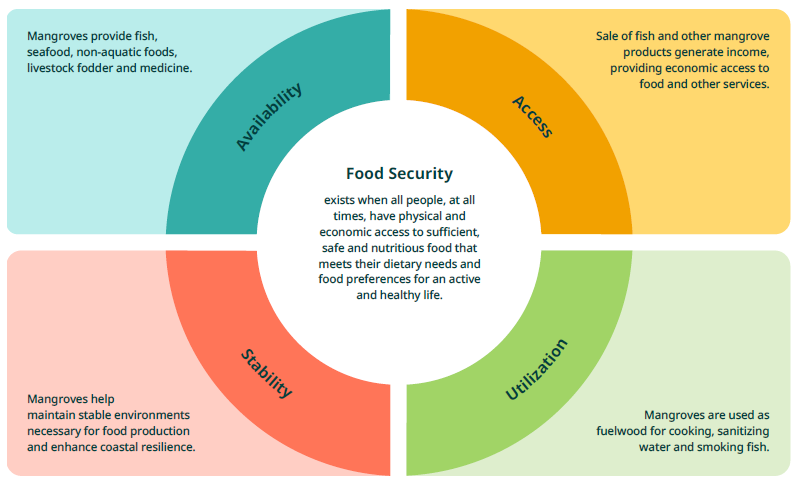
Figure 1: The many ways in which mangroves contribute to the four dimensions of food security.
(Source: FAO in State of the World’s Mangroves 2024.)
Coastal ecosystems support communities with access to food, feed, fibre and livelihoods, and through them, help reduce vulnerability to climate change, enhance adaptive capacity and resilience.
Analysing the adaptation sections of nationally determined climate commitments (NDCs), FAO was able to summarize that over half, or 55 percent, of all 175 NDCs submitted by the Parties to the United Nations Framework Convention on Climate Change included wetland-related climate change adaptation actions (as on 29 July, 2025). Of the countries that specify the type of wetlands, mangroves are specifically mentioned in less than 30 NDCs, often together with other coastal ecosystems for their multiple benefits.
Several assessment tools and monitoring platforms offer opportunities to better understand the status of mangroves, and how to enhance their management. The IUCN Red List of Ecosystems provides a standardized framework to assess risks facing mangrove ecosystems. Artificial intelligence powered systems, such as that of China’s national Smart Wetland System, offer high-resolution data for biodiversity and carbon tracking.
FAO’s The world’s mangroves 2000–2020 report, now in the process of updating to 2025, provides a global overview and regional insights into the status and trends in mangroves, including the drivers of mangrove losses and gains. This initiative, implemented under the Global Forest Resources Assessment (FRA) Remote Sensing Survey project, makes use of national expertise to analyze mangroves using Collect Earth platform.
National wetland or forest inventories, assessments and community-based monitoring are essential for localized data and adaptive management, and provide key information also for global products, such as the Global Mangrove Watch. FAO’s SEPAL platform allows countries to collect and analyze large datasets on cloud-based platforms. The GEO Wetlands Initiative supports coordinated efforts to enhance the wetland monitoring and reporting efforts focusing on earth observation data, and supports the Parties to the Convention on Wetlands.
Monitoring efforts for climate and biodiversity purposes are expected to use both the Kunming-Montreal Global Biodiversity Framework (KMGBF) under the Convention on Biological Diversity (CBD), and the upcoming indicators for the Global goal on adaptation (GGA) under the Paris Agreement. This will allow countries to advance with understanding how mangroves and their ecosystem services are impacted and evolve. Integration of coastal ecosystems to the national monitoring, evaluation and learning (MEL) systems that countries have committed to operationalize by 2030 for adaptation, give an opportunity to enhance our understanding, and address various threats to our coastlines in a holistic manner.
Several mangrove-focused initiatives exist emphasizing mangrove conservation and restoration. The Global Mangrove Alliance (GMA) and Mangrove Breakthrough aim to halt mangrove loss, restore half of restorable mangroves lost since 1996, and double protection coverage, underpinned by $4bn of sustainable finance. For restoration, they advocate for a shift from planting to ecological restoration, better understanding and recovery of hydrology and sediment flow to enable natural regeneration, and species diversity.
The International Mangrove Center (IMC) operates under the Convention on Wetlands as an intergovernmental organization and RRI to advance coordinated action among its member states. Its mission is to promote international cooperation and joint actions in mangrove conservation, restoration, and wise and sustainable use; strengthen the implementation of the Convention, and other relevant current and future environmental commitments, including but not limited to the KMGBF, the Paris Agreement, the 2030 Agenda for Sustainable Development along with its SDGs.
To advance this mission, the IMC promotes knowledge sharing and joint research, enhances technology transfer and training, develops education and public awareness, and supports pilot projects. It is now putting these priorities into practice through regular training workshops, the development of a global mangrove data and knowledge platform, small-scale funded projects, and the documentation and exchange of best practices to support policy and implementation.
Sustainable management and conservation of forest and coastal ecosystems are among the most effective climate change adaptation strategies, and provide significant mitigation co-benefits (IPCC, 2022). Following this, countries are emphasizing both the national adaptation plans (NAPs) and NDCs’ adaptation action coastal ecosystem conservation and restoration, especially integrated approaches that combine ecological protection with climate resilience. Key measures include expanding marine protected areas, restoring mangroves and seagrasses through national programs, and implementing adaptive management plans informed by biodiversity and ecosystem service assessments. Countries are committing to updating coastal wetland inventories, establishing monitoring systems, and enhancing carbon sequestration and storage through blue carbon initiatives.
Case studies from Pakistan, Belize and China highlighted at the side event show that community-led restoration, combined with innovative, digital fundraising platforms have significantly enhanced impact. Communication, Education, Participation, Awareness initiatives (CEPA under the Ramsar Convention on Wetlands) approaches are seen as vital for mobilizing public support. In some cases, civil society organizations are engaged in managing protected areas, and a large share of examples are engaging communities in restoration activities.
Mobilizing high-integrity climate and biodiversity finance is critical. In the current environmental finance landscape, emphasis is increasingly on realistic costing of action, and blended finance approaches, taking advantage of a variety of sources for different types of resources (e.g. human resources, equipment, technology, loans, grants). As an example, the MCF took advantage of an e-commerce platform selling furniture by dedicating part of the revenue from over 160 million orders to financing estuarine wetland restoration and conservation in China.
Technical and development agencies and organizations are often requested to support national and local actors in developing reliable financial solutions, policy environments and develop stakeholders’ capacity for sustainable coastal development. International cooperation platforms such as IMC, MAC, the Mangrove Breakthrough and GMA could identify the comparative advantages and opportunities for coordinated action for ever more effective support and impact.
Collaborating to develop and promote global and national policies that support mangrove conservation and restoration, including integrating them into national adaptation plans and climate and biodiversity strategies (such as National Biodiversity Strategies and Action Plans or ‘NBSAPs’) as priorities, where appropriate.
Enhancing monitoring and data systems deploying the most suitable, robust technology, taking into consideration the stakeholder capacity and means. Artificial intelligence, remote sensing tools and facilitated data exchange hold promises to support enhanced decision making.
Scaling up restoration through science-based, and proven ecological approaches, promoting community-based ecosystem restoration with livelihood benefits, and developing technical guidelines and capacity-building programs.
Mobilizing finance: consolidating budgets aligned with climate priorities, supporting bankable project design, and making sustainable financial resources accessible to holistic projects and programmes for coastal conservation and restoration.
Aligning coastal actions with national development and global goals by advocating for dedicated funding streams and aligning mangrove actions with the targets of the SDG 6.6.1, Convention on Wetlands, CBD Global Biodiversity Framework (GBF) indicators, and the UAE Framework for Global Climate Resilience.
Supporting inventories, monitoring, learning and reporting efforts for climate action for adaptation and mitigation, biodiversity and socio-economic benefits.
Empowering communities and fostering innovation by supporting community-led restoration and encouraging use of innovative means for fundraising and citizen science.
Further developing international cooperation and knowledge exchange by strengthening collaborative initiatives, such as the UN Decade on Ecosystem Restoration, IMC, MAC, International Partnership for Blue Carbon (IPBC), and Mangrove Breakthrough as global hubs, their coordinated support, and promoting regional and thematic networks, including with private sector actors.
Encouraging and supporting collaborative research and knowledge exchange with other international and regional coastal ecosystem platforms that enhance mangrove conservation and restoration strategies: facilitate the exchange of scientific research findings, technical expertise, best practices, and capacity development including knowledge exchange targeting various stakeholder groups.
Mangrove inventories and monitoring are foundational to ensure that coastal ecosystem conservation and restoration efforts are effective for people and nature. Across consultations, events and meetings, countries highlight the need for enhanced capacity from the coastal villages to national coordination efforts.
International collaboration is central to scaling up mangrove conservation. Initiatives such as IMC, MAC, GMA and the GEO Wetlands Initiative provide platforms for knowledge exchange, joint restoration efforts, and support policy alignment. IMC’s cooperation on mangroves and coastal wetlands around the Equator, Australia's leadership in IPBC, Global Mangrove Watch’s publicly available data, and GMA’s finance mobilization efforts are a few examples of the power of partnerships.
Looking ahead, as coastlines evolve and climate pressures intensify, global initiatives and the countries they support stand to gain immensely from deeper coordination – unlocking shared solutions, accelerating impact, and building resilient coastal futures together.
References
FAO. 2023. The world’s mangroves 2000–2020. Rome. https://doi.org/10.4060/cc7044en.
IPCC, 2022: Climate Change 2022: Impacts, Adaptation, and Vulnerability. Contribution of Working Group II to the Sixth Assessment Report of the Intergovernmental Panel on Climate Change [H.-O. Pörtner, D.C. Roberts, M. Tignor, E.S. Poloczanska, K. Mintenbeck, A. Alegría, M. Craig, S. Langsdorf, S. Löschke, V. Möller, A. Okem, B. Rama (eds.)]. Cambridge University Press. Cambridge University Press, Cambridge, UK and New York, NY, USA, 3056 pp., doi:10.1017/9781009325844.
Shono, Kenichi & Nuutinen, Maria (2024): 5.1 Food security and mangroves. In Leal, Maricé and Spalding, Mark D (editors), 2024. The State of the World’s Mangroves 2024. Global Mangrove Alliance. DOI: https://doi.org/10.5479/10088/119867.
Further information
Convention on Wetlands Conference of Contracting Parties report and resolutions: https://www.ramsar.org/meeting/15th-meeting-conference-contracting-parties
Global goal on adaptation: https://unfccc.int/topics/adaptation-and-resilience/workstreams/gga
Global Mangrove Alliance: https://www.mangrovealliance.org/
FAO on mangrove management: https://www.fao.org/forestry/mangrove
International Mangrove Center https://www.imc.int/
Mangrove Breakthrough: https://www.mangrovebreakthrough.com/about
UNFCCC NDC registry: https://unfccc.int/NDCREG